
Sierra Leone - Economy
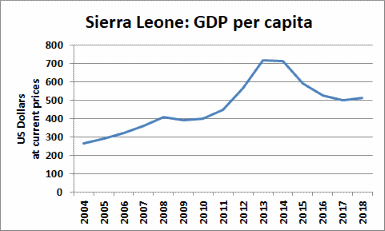
GDP per capita – 514 US dollars (2018, at current prices, UNCTAD).
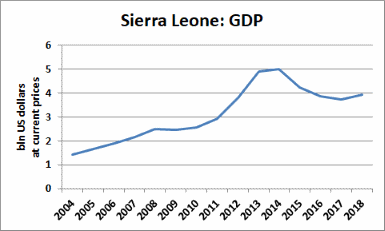
GDP – 3,9 bln US dollars (2018, at current prices, UNCTAD).
GDP - gross domestic product
Exports (marchandise) – 554 mln US Dollars (2018, at current prices, UNCTAD).
Imports (marchandise) – 1,4 bln US Dollars (2018, at current prices, UNCTAD).
Exports (services) – 156 mln US Dollars (2017, at current prices, UNCTAD).
Imports (services) – 428 mln US Dollars (2017, at current prices, UNCTAD).
Main export commodities - diamonds, rutile, cocoa, coffee, fish.
Main import commodities - foodstuffs, machinery and equipment, fuels and lubricants, chemicals
https://www.cia.gov/library/publications/the-world-factbook/geos/sl.html
Economy overview
Sierra Leone is an extremely poor nation with tremendous inequality in income distribution. While it possesses substantial mineral, agricultural, and fishery resources, its physical and social infrastructure has yet to recover from the civil war, and serious social disorders continue to hamper economic development. Nearly half of the working-age population engages in subsistence agriculture. Manufacturing consists mainly of the processing of raw materials and of light manufacturing for the domestic market. Alluvial diamond mining remains the major source of hard currency earnings, accounting for nearly half of Sierra Leone's exports. The fate of the economy depends upon the maintenance of domestic peace and the continued receipt of substantial aid from abroad, which is essential to offset the severe trade imbalance and supplement government revenues. The IMF completed a Poverty Reduction and Growth Facility program that helped stabilize economic growth and reduce inflation and in 2010 approved a new program worth $45 million over three years. Political stability has led to a revival of economic activity such as the rehabilitation of bauxite and rutile mining, which are set to benefit from planned tax incentives. A number of offshore oil discoveries were announced in 2009 and 2010. The development on these reserves, which could be significant, is still several years away, however, growth skyrocketed to more than 20% in 2012, as exploitation activities began.
https://www.cia.gov/library/publications/the-world-factbook/geos/sl.html
Annual production of Sierra Leone's diamond estimates range between US$250 million–$300 million. Some of that is smuggled, where it is possibly used for money laundering or financing illicit activities. Formal exports have dramatically improved since the civil war, with efforts to improve the management of them having some success. In October 2000, a UN-approved certification system for exporting diamonds from the country was put in place and led to a dramatic increase in legal exports. In 2001, the government created a mining community development fund (DACDF), which returns a portion of diamond export taxes to diamond mining communities. The fund was created to raise local communities' stake in the legal diamond trade.
Since the end of hostilities in January 2002, massive infusions of outside assistance have helped Sierra Leone begin to recover. Much of the recovery will depend on the success of the government's efforts to limit corruption by officials, which many feel was the chief cause for the civil war. A key indicator of success will be the effectiveness of government management of its diamond sector.
Sierra Leone has one of the world's largest deposits of rutile, a titanium ore used as paint pigment and welding rod coatings. Sierra Rutile Limited, owned by a consortium of United States and European investors, began commercial mining operations near the city of Bonthe, in the Southern Province, in early 1979. It was then the largest non-petroleum US investment in West Africa. The export of 88,000 tons created $75 million in export earnings in 1990. In 1990, the company and the government made a new agreement on the terms of the company's concession in Sierra Leone. Rutile and bauxite mining operations were suspended when rebels invaded the mining sites in 1995, but exports resumed in 2005. The new Mines and Minerals Act was passed by Parliament in November 2009, which aimed to improve concessions management in the Ministry of Mineral Resources. Sierra Leone is an EITI candidate country. In January 2012, the government launched the GoSL Online Repository, which makes public all mining licenses and related payments recorded.
About two-thirds of the population engages in subsistence agriculture, which accounts for 52.5% of national income. The government is trying to increase food and cash crop production and upgrade small farmer skills. The government works with several foreign donors to operate integrated rural development and agricultural projects.
Despite its successes and development, the Sierra Leone economy still faces significant challenges. There is high unemployment, particularly among the youth and ex-combatants. Authorities have been slow to implement reforms in the civil service, and the pace of the privatisation programme is also slacking and donors have urged its advancement.
http://en.wikipedia.org/wiki/Sierra_Leone#Economy
Finance
The currency is the leone. The central bank of the country is the Bank of Sierra Leone which is in the capital, Freetown. The country operates a floating exchange rate system, and foreign currencies can be exchanged at any of the commercial banks, recognised foreign exchange bureaux and most hotels. Credit card use is limited in Sierra Leone, though they may be used at some hotels and restaurants. There are a few internationally linked automated teller machines that accept Visa cards in Freetown operated by ProCredit Bank http://en.wikipedia.org/wiki/Sierra_Leone#Economy
Exchange Rate
1 US Dollar = 7455 SLL, 1 euro = 7954,97 SLL (13.04.2017)
www.finance.yahoo.com/currency-converter
- 3609 просмотров