
Conditions for Doing Business in Côte d'Ivoire
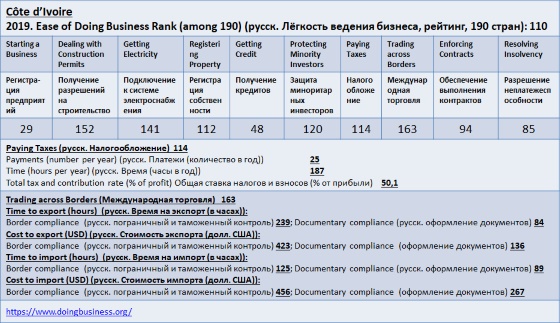
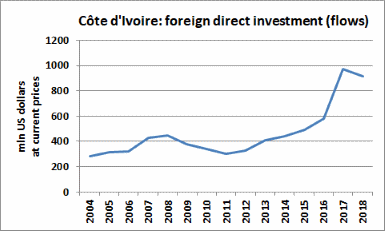
Côte d'Ivoire: flow of FDI in 2018 - 912,6 mln US Dollars (at current prices, UNCTAD)
FDI - Foreign Direct Invetsment
Africa Capacity Index (ACI) 2019
Since 2011, the African Capacity Building Foundation (ACBF – specialized agency of the AU, located in Harara, Zimbabwe https://www.acbf-pact.org/) publishes an annual Africa Capacity Report (ACR).
The ACR measures and examines the capacity of African countries to pursue their development agenda, focusing on key determinants and components of capacity for development. ACBF defines capacity as the “ability of people, organizations, and society as a whole to manage their affairs successfully” and capacity development as the process by which “people, organizations, and society as a whole unleash, strengthen, create, adapt, and maintain capacity over time.
Capacity of African countries, examined in ACR, is reflected by Africa Capacity Index (ACI). The ACI - is a composite index computed from a quantitative and qualitative assessment of four sub-indices or indicator “clusters” on a specially designed questionnaire. “The policy environment cluster” considers the conditions that must be in place to make transformational change and development possible. “The processes for implementation cluster” assesses the extent to which countries are prepared to deliver results and outcomes. “The development results at country level cluster” refers to tangible outputs that encourage development. And “the capacity development outcomes cluster” measures change in the human condition.
Côte d'Ivoire ACI 2019 Rank 15 Score 56.2
Cluster 1 Policy environment for capacity development 97.4
Cluster 2 Processes for implementation 47.9
Cluster 3 Development results at country level 100.0
Cluster 4 Capacity development outcomes 33.3
Incentives and Guarantees for foreign investors
In Côte d'Ivoire the main low which regulates foreign investments juridically is The Investment code (French – Code des investissements) of 3rd of August 1995. Besides this code, economic activity for foreign investors is determined in regulatory enactments in corresponding areas.
With the purpose of foreign investments’ advancement in Côte d'Ivoire was created Center of investments’ advancement (French - Centre de Promotion des Investissements en Côte d'Ivoire).
The Government of Côte d'Ivoire encourages FDI, especially the type that contributes to the country's economic development. It provides exemption from tax and custom duties for such investors. Investments from outside the Franc zone require government approval. Purchases of real estate are permitted, but they must be reported to the government if they involve investment in an enterprise, branch, or corporation.
The infrastructure in Côte d'Ivoire is improving. The telecommunications industry has experienced extremely rapid growth since the granting of a first GSM license and the government’s sale of the national telecommunications company, Citelcom, to France Télécom. By 2001, Côte d'Ivoire Télécom was operating thousand of lines, much higher than at the time of privatization. There are three mobilephone companies operating in the country: Société ivoirienne de mobiles (SIM, otherwise known as Ivoris), pan-African Telecel, and Cora de Comstar.
The Côte d'Ivoire signed to the Convention on the Settlement of Investment Disputes between State and Nationals of other States on June 30, 1965 and is a member of other regional integration schemes. Among them are WAEMU, which imposes a common external tariff, the African Union, New Partnership for Africa's Development and the Economic Community of West African States. The country is eligible for the Cotonou Agreement for renegotiating the trade partnership agreement between the African, Caribbean and Pacific countries with the European Union. Côte d'Ivoire is member of the Multilateral Investment Guarantee Agency and the World Trade Organization [UNCTAD. World investment directory. Volume X. Africa. United Nations. N.Y. and Geneva. – 2008, p. 205].
Prospects for economic cooperation with Cote d’Ivoire:
- agroindustry;
- processing of foodstuff;
- mining;
- machine building;
- fishing;
- manufacturing;
- construction;
- energy;
- transportation;
- education;
- scientific cooperation on oceanography and agroindustry;
- tourism.
- 2548 reads